Role
Senior UX / Product DesignerResearch → UI
The Hiring Approval Request Tool centralizes how hiring requests are raised, routed, and approved across a seven-level chain — from Hiring Manager to HR Business Partner. This is the research that shaped it: personas, problem framing, and use cases that defined scope before design.
No standard workflow, no real-time visibility, no reliable audit trail. Hiring slowed, accountability blurred, and governance, delegation, and reporting were all manual.
Managers chased approvers over email with no view of where a request was stuck.
The hierarchy was tracked by hand; self-approval and skipped levels went unnoticed.
No way to delegate or reassign without breaking the chain.
FTE or Contract
First gates
Budget & plan
Starts recruitment
The chain adapts to the requester's designation, skipping their own level so no one approves their own request.
I mapped every role in the approval chain as a persona. Each has a different job in the same request, so each needs its own view.
Goal: Fill roles fast, track every request.
Friction: Chasing approvers; no status view.
Needs: Guided form, live tracking, My Insights.
Goal: Decide quickly; keep things moving when away.
Friction: Incomplete requests; stalls during absence.
Needs: Full-context queue, delegation, team view.
Goal: Align hires with budget and headcount.
Friction: Cumulative impact hard to weigh.
Needs: Aggregated Team Insights, reassignment.
Goal: Govern hiring against plan.
Friction: No single view of volume and spend.
Needs: Roll-up insights, enforced rules.
Goal: Steer org-wide hiring strategy.
Friction: No trend view; audit gaps.
Needs: Organization Insights, full audit trail.
Goal: Recruit on complete, approved requests.
Friction: Missing approvals; unclear delegation.
Needs: Auto-handoff with “approved by X on behalf of Y”.
Raise, route, review, and track in real time — with self-approval skipping, automatic HRBP handoff, and a complete audit trail.
Leads manage members, reassign in-flight requests, and delegate approval authority for a set period — without breaking governance.
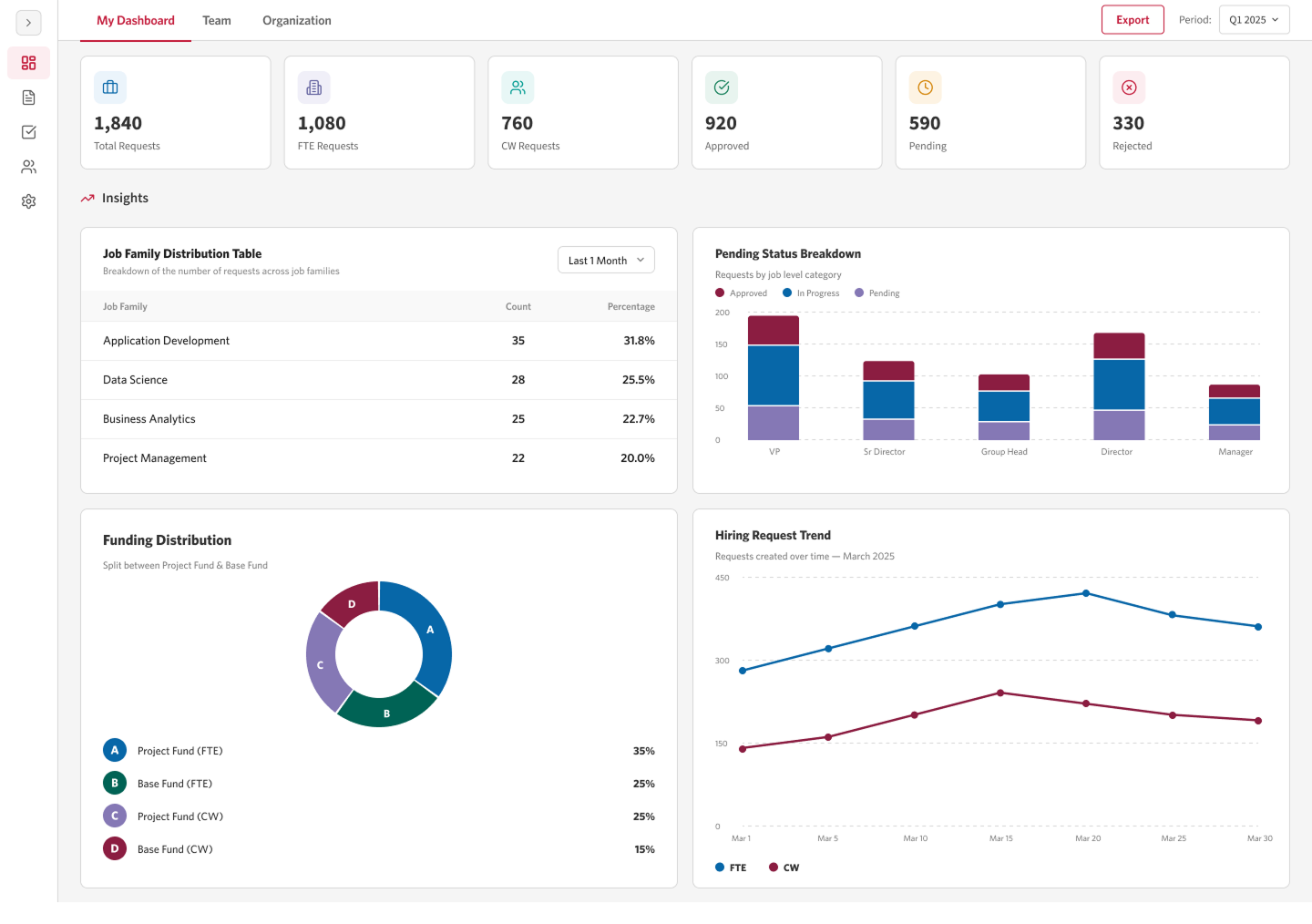
My Insights for individuals, Team Insights for leads, Organization Insights for executives — volume, cycle time, bottlenecks, and budget vs. plan.
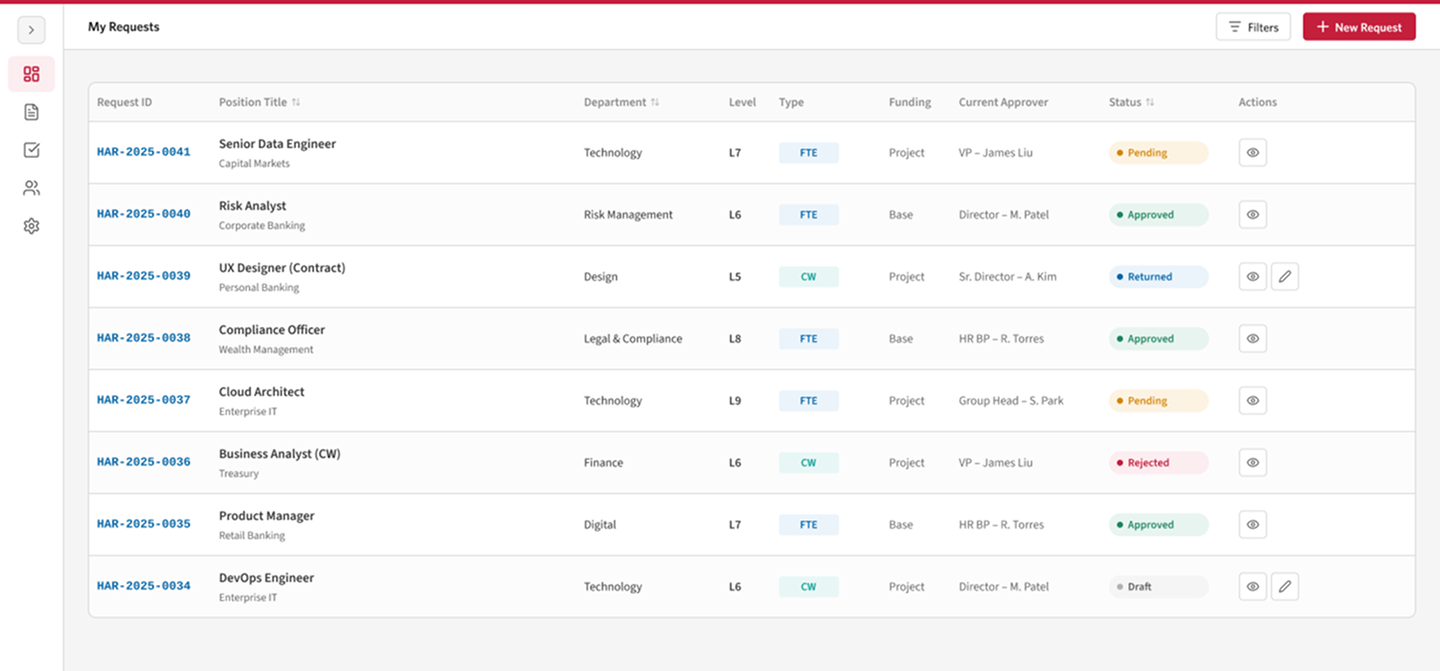
One table shows position, department, level, FTE or contract type, funding, the current approver, and live status — so no one has to chase an email thread to know where a request stands.
Structured routing and delegation remove email chasing and absence stalls.
Hierarchy and self-approval rules enforced by the system, not by memory.
Every approval, comment, and delegation timestamped and searchable.
Headcount and spend vs. allocation, visible from team to org level.